
Friday, May 4, 2012

Friday, April 27, 2012

Wednesday, April 25, 2012
Artist Share: Josephine Pryde
Josephine Pryde is a contemporary artist born in Alnwick, UK in 1967. She received her BFA from Central St. Martins School of London and her MFA from Wimbledon School of Art in London. Pryde primarily uses installation and photography as mediums for her expression. Conceptually, her work has touched on numerous idea systems, including but not limited to, post modernist critiques, human/viewer interaction with art, as well as commodification of imagery. Her focus on commodity intrigued me to look more deeply into her work, primarily at her most recent show and first retrospective at the Kunstverein Gallery in Dusseldorf.
This retrospective, entitled 'Miss Austen Enjoys Photography,' is not only a retrospective, but a showcase of brand new work that Pryde actually shot and printed on site. Her subject matter for these images are over 30 guinea pigs of different colors shapes and sizes. Each one photographed at different angles and depths of field. These were shot in large format and printed large as well in bold color giving an almost overwhelming 'cute factor' the moment the viewer enters the gallery. The obvious connotation to guinea pigs as pets as well as their use for lab research as test subjects gives an almost disturbing ambiance to this section of the show. There is also the connotation of the constantly growing number of kitsch photography revolving around cute pets that fills Flickr accounts as well as the cameras of parents with small children bringing home their new family additions to the household.
 The entire idea of creating work and showcasing at literally in the same space brings to question the idea of commodity and consumption through the production of 'cute' imagery that is almost arresting to the viewer, distracting him/her from broader concepts being commented on, let alone the rest of the retrospective. But this arrest of thought is a fantastic example of the commodification that people experience every day, but nonchalantly absorb.


This retrospective, entitled 'Miss Austen Enjoys Photography,' is not only a retrospective, but a showcase of brand new work that Pryde actually shot and printed on site. Her subject matter for these images are over 30 guinea pigs of different colors shapes and sizes. Each one photographed at different angles and depths of field. These were shot in large format and printed large as well in bold color giving an almost overwhelming 'cute factor' the moment the viewer enters the gallery. The obvious connotation to guinea pigs as pets as well as their use for lab research as test subjects gives an almost disturbing ambiance to this section of the show. There is also the connotation of the constantly growing number of kitsch photography revolving around cute pets that fills Flickr accounts as well as the cameras of parents with small children bringing home their new family additions to the household.


http://www.contemporaryartdaily.com/2012/03/josephine-pryde-at-kunstverein-dusseldorf/
Saturday, April 21, 2012

Friday, April 13, 2012

Thursday, April 12, 2012
Calm Before the Storm Essay
For this essay I chose Camille Seaman’s Crumbling Iceberg
1. This piece was part of a large body
of work Seaman created, primarily based out of the Arctic and Antarctic. These works consisted of varying landscapes
throughout this area, giving a beautiful and still feeling that seemed to emanate
from each piece.
When I first saw this piece, and this show in particular, the shear size
of all of the works done by Seaman was amazing and very immersive. Easily 5 feet wide, each image gave the
viewer a true viewing experience, inviting him/her to go closer. This is where the issues occur. Upon a closer inspection, the image was
extremely noisy. This seems like a
trivial issue for an image with so much going for it aesthetically. The composition is phenomenal, as well as the
vingetting, which added a really nice feeling to the horizon in
particular. The image was shot on
panoramic medium format film that Seaman later discussed as being high speed
due to the boat she was on during the trip moving a lot during some of her
photographs, however this one in particular was shot off of the boat on a still
surface. It may seem as if I am harping
on something that could easily be overlooked, but if an image is printed at
such an enormous scale, it asks the viewer to go closer and examine it in fine
detail.
In terms of interpretation, the
image conveys a sense of pure cold beauty.
A king of stillness occurs that displays the isolative and quiet
qualities that surround the areas. There
is also a large environmental aspect to this piece, bringing the viewer to the
front row of climate change, literally watching the glacier depicted almost
wither away in its fragility.
In conclusion, Seaman’s Crumbling Iceberg
1, is an inherently aesthetically appealing image. However the lack of attention to detail
becomes detrimental to the work and distracts the viewer from the conceptual
basis and meaning.

Friday, April 6, 2012

Monday, April 2, 2012
Find Your Muse: Ralph Eugene Meatyard
Ralph Eugene Meatyard was born in 1925 and began his career in Lexington Kentucky as an optician. The company Meatyard worked for also sold photographic equipment at the time, and its members were also active in the Lexington Camera Club in the art department of the University of Kentucky. This prompted him to become initially interested in photography and led to his eventual purchase of his first camera in 1950 in order to photograph his son. After experimenting with it, he soon joined the Lexington Camera Club and then later became a member of the Photographic Society of America.
During his membership he met Van Deren Coke, who would influence Meatyards work greatly. He also attended several workshops during the mid 50's run by Minor White and Henry Holmes Smith. This led to extremely experimental works he would create in his darkroom at his home. He died in 1972.
His work was shown in numerous galleries and publications and was regarded as some of the most original and disturbing work to be made with a camera at the time.
Meatyard's work consists of various juxtapositions of old and young bodies as well as grim/gloomy representations of the south and midwest. His images portray eerie yet beautiful narratives regarding human interaction through time as well as identity as it relates to physical form.

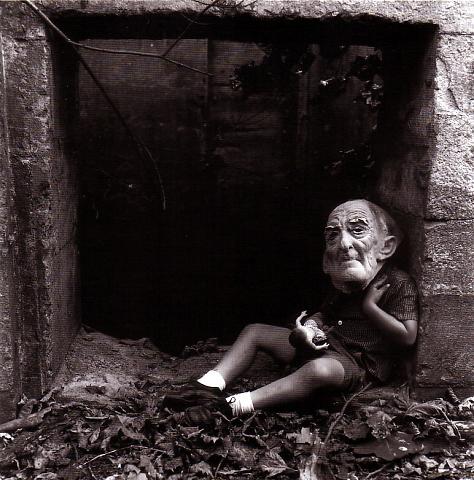
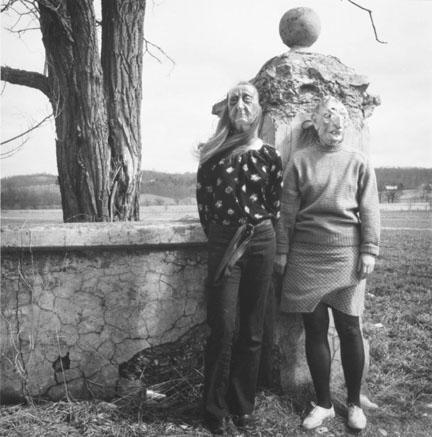
During his membership he met Van Deren Coke, who would influence Meatyards work greatly. He also attended several workshops during the mid 50's run by Minor White and Henry Holmes Smith. This led to extremely experimental works he would create in his darkroom at his home. He died in 1972.
His work was shown in numerous galleries and publications and was regarded as some of the most original and disturbing work to be made with a camera at the time.
Meatyard's work consists of various juxtapositions of old and young bodies as well as grim/gloomy representations of the south and midwest. His images portray eerie yet beautiful narratives regarding human interaction through time as well as identity as it relates to physical form.
Friday, March 30, 2012

Monday, March 26, 2012
Advanced Photo Artist Share: Yukinori Yanagi
Yukinori Yanagi
Yukinori Yanagi was born in Fukuoka, Japan in 1959. He received his BFA in painting from the
Musashino Art University in Tokyo in 1983 as well as his MFA in painting in
1985 from the same school. In 1990 he
went on to receive a second MFA in sculpture from Yale and currently teaches at
the Hiroshima City University in Japan.
Yanagi’s work conceptually discusses national and
international identity as it relates to living and making art in Japan as well
as borders and assigned roles or duties.
My main interest in him stems from his use of insects (primarily ants)
to convey the notion of mindless work or a specific place or set standard for
different groups of people which can have negative or positive effects on
society as a whole. This insect artist
relationship is something I would like to incorporate into my own work in one
way or another, mainly because I believe it can be construed to symbolize not
only human population on a large scale, but a natural and un planned
deterioration of a given concept depicted visually through a photograph. I also
want to use the idea of consumption or eating as it relates to insect
involvement in my own work.
Union Jack Ant Farm

This piece depicts an art farm using sand colored in a way
that creates the British flag. Ants
slowly move about the piece, deteriorating the overall image and create a
tarnished and tunnel riddled flag.
“It simultaneously
depicts thee spread of a tribe and the decline of an empire.”- Yanagi
Wandering Position

Yanagi placed himself in a 15-foot square frame where for
hours on end for several days he would follow one ant around slowly, tracing
its path with a crayon. Yanagi states
that this piece is primarily about animal artist relationship as well as
confinement of a worker and actions taken based on enclosure. Yanagi installed this piece at several
different locations primarily Alcatraz and his studio in North America. The locations of these installations were a
key component in each of their meanings and posed different conceptual
statements and questions.
World Flag Ant Farm

This piece at a glance seems to be a wall of encased flags
from all over the world, but at a closer look Yanagi has made ant farms of each
major country in the world and interconnected all of them. This creates a slow but steady mixture of
sand from one ant farm to another, showing a fantastic relation between the
intermingling of culture throughout the world.
The longer the piece is up, the more deconstructed each country’s flag
gets individually, and the more connected the overall piece becomes
visually.
Friday, March 23, 2012

Tuesday, March 20, 2012

Friday, March 16, 2012

Friday, March 9, 2012

Friday, March 2, 2012

Friday, February 24, 2012

Friday, February 17, 2012

Tuesday, February 14, 2012

Friday, February 10, 2012

Tuesday, February 7, 2012

Saturday, January 28, 2012


Tuesday, January 24, 2012


Saturday, January 21, 2012

Tuesday, January 10, 2012
Subscribe to:
Posts (Atom)